

Your Accountant Is Not Your Strategic Advisor (And Neither Is Your Bookkeeper)

By Paco De Leon

“I want a bookkeeper who can tell me what I should be doing in my business,” a well-meaning business owner once told me on a phone call.
No disrespect to bookkeeping and bookkeepers, but that’s like expecting the buser at a restaurant to have the same insights and skills as the head chef. It’s like hiring a web developer or graphic designer and expecting them to also be experts in brand strategy. It’s like thinking a wedding photographer could also be the wedding planner.
I know that last analogy is completely unhinged because it’s so blatantly obvious that those skill sets differ, and the only thing in common is the fact that they work in the same industry, but it’s not far off from the point I’m trying to drive home. If I may just torture this analogy a bit more, a wedding photographer documents what’s happened at a wedding (like a bookkeeper), and the wedding planner designs, strategizes, and helps lead the execution (CFO).
What are the differences between a bookkeeper, an accountant, and a CFO?
Don’t worry if you’ve conflated all these roles before. Unless you’ve taken the time to sit down and learn the differences between them, you’re unlikely to understand exactly how they all work together and support business owners in different ways.
Compliance vs. Strategy
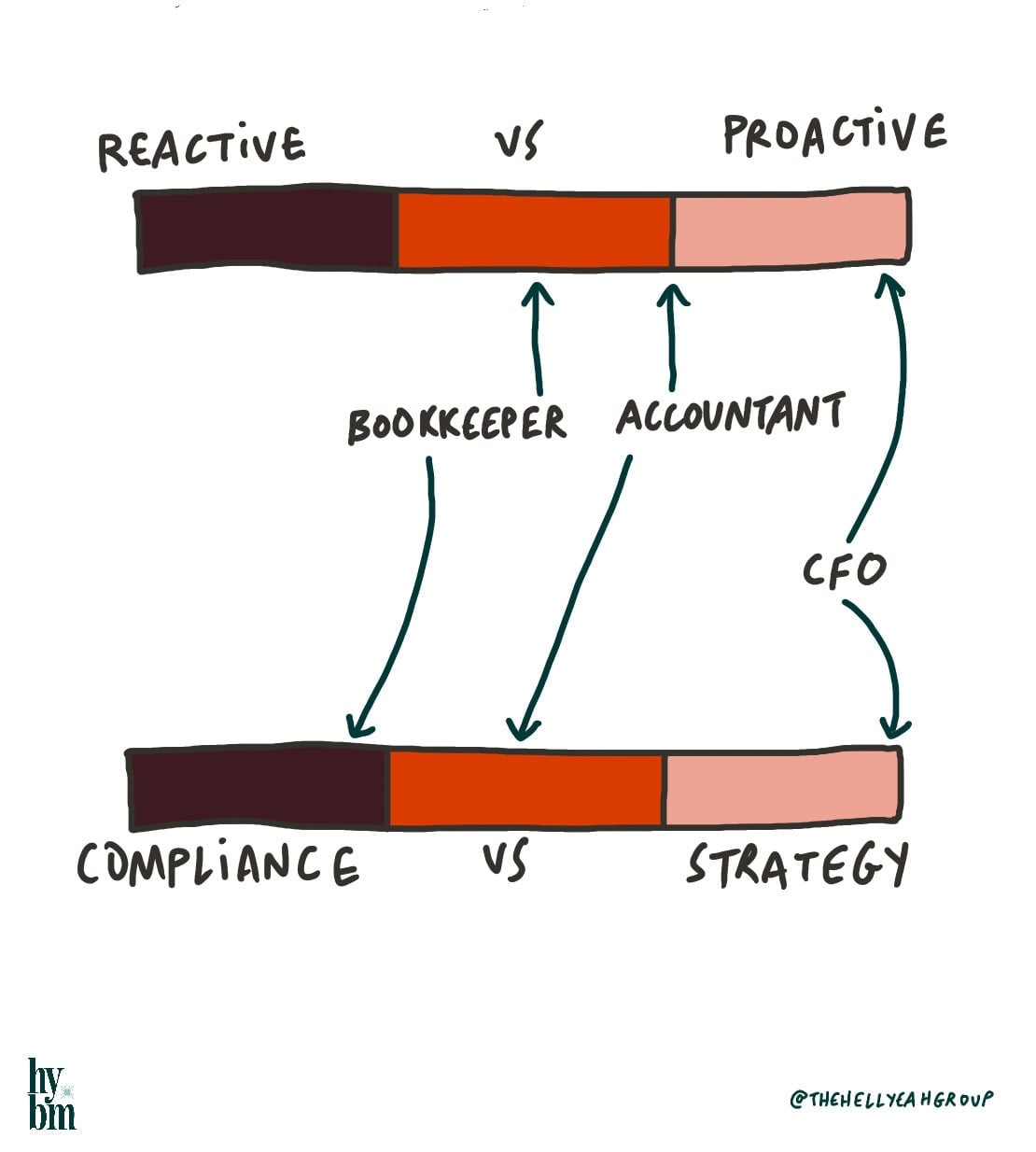
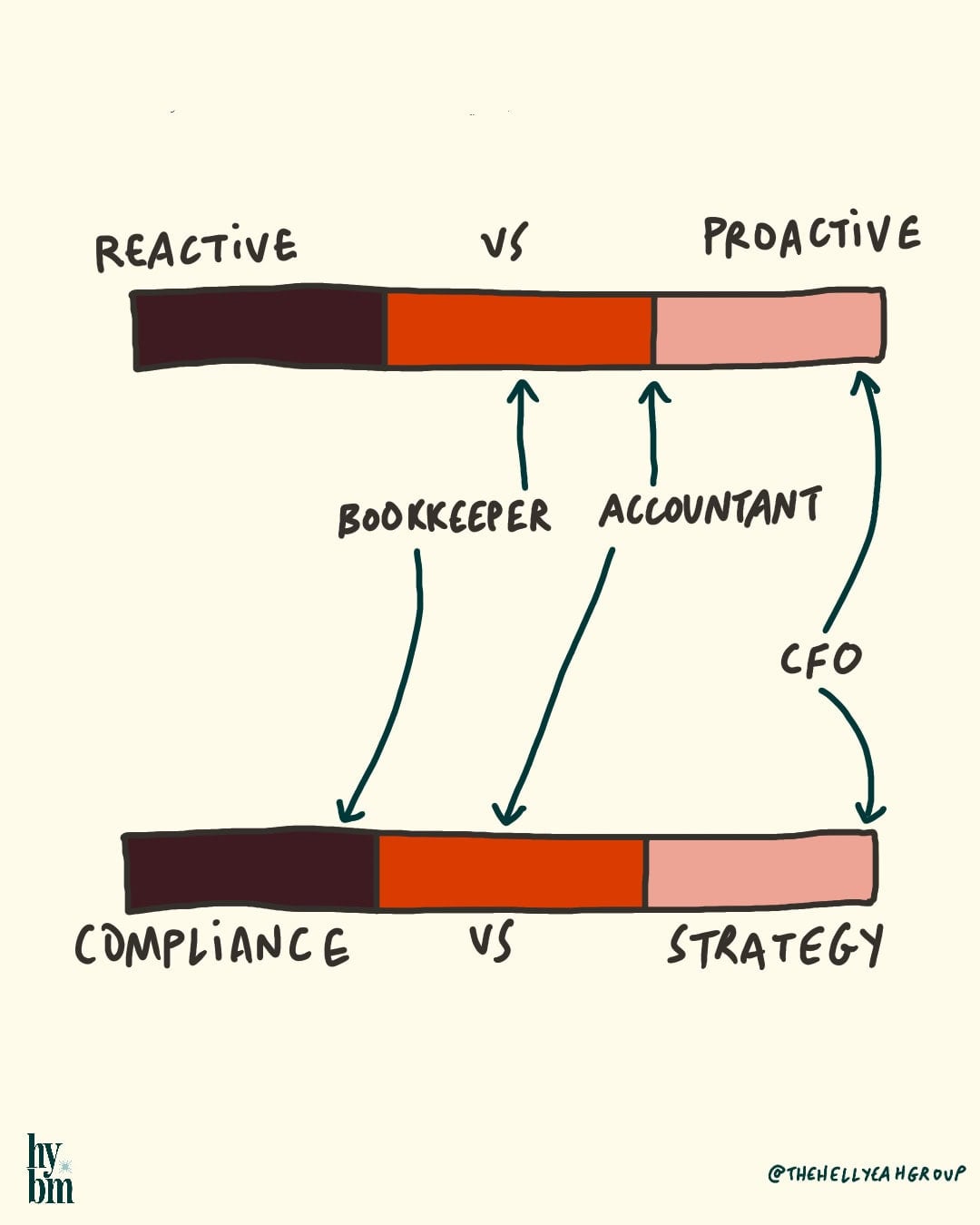
The main difference between a bookkeeper, an accountant (also sometimes called a CPA), and a CFO is their focus. Your Bookkeeper and accountant are focused on compliance, while your CFO is focused on strategy. “Compliance” means following the rules by keeping your books and filings clean, accurate, and legal.
Reactive vs. Proactive
Another difference between your bookkeeper and a strategic partner is how accounting work is often reactive. It’s all about accurately recording what has already happened and ensuring it’s properly documented. Strategy, on the other hand, is proactive. It’s about analyzing historical data to project future scenarios. A cash flow model is a proactive exercise to understand how much cash the business should have over the near term and what to do in cases where cash is needed to keep operations going until payments come in.
Know the Roles
The Role of Your Bookkeeper
Your bookkeeper is responsible for making sure day-to-day financial records are clean, accurate, and traceable so that when it’s time to file taxes or produce reports, everything lines up. They make sure the historical data is accurate and compliant with accounting standards since the reports they generate will be used for tax filings that your account handles.
Typical bookkeeping compliance-related duties include the following:
- Categorizing income and expenses correctly according to tax and accounting standards
- Reconciling accounts so balances are accurate and provable if you were ever subject to an audit by the IRS or bank
- Help you keep proper records of receipts, invoices, and payroll
- Making sure sales tax, payroll tax, and 1099 records are tracked correctly
- Ensuring the books reflect reality so that someone else (the CPA or the IRS) won’t find errors later
- Some bookkeepers also handle financial operational tasks like invoicing (AR), paying bills or contractors (AP), and running payroll
In short, bookkeepers keep you compliant operationally. This means keeping your records accurate, organized, and ready to show the IRS, your CPA, a bank, or an auditor if they ever come asking.
The Role of Your Accountant
Every year, you and your business are required to file and pay taxes. Here in the US, the ever-growing and already-dense tax code is the rule book for tax filings. Your accountant’s job is to interpret and apply the tax code to file your taxes. See what I mean when I say bookkeeping, accounting, and tax filing all fall under the category of compliance?
Here are some typical accountant duties:
- Preparing and filing tax returns (income, sales, payroll, franchise, etc.)
- Giving you tax advice or being your tax counselor. For example, helping you with a tax projection at the end of the year, before you file your taxes.
- Making sure filings follow IRS, GAAP, or state requirements
- Advising on deductions, depreciation, and accounting methods that meet regulations.
- Ensure your financial statements can withstand audit or tax scrutiny by advising your bookkeeper on adjustments that need to be made to the financials.
- Keeping the business in good standing with state and federal agencies
In short, accountants keep you compliant legally by ensuring you meet filing and tax rules. They can also help you with tax advice and tax projections.
The Role of Your CFO
A CFO, which stands for Chief Financial Officer, is focused on strategy. Strategy means using the financial data that the bookkeeper manages to make wise decisions about the future. They turn what’s already happened into insight about what to do next. A CFO looks beyond compliance and reporting to connect money with mission, helping leadership decide how to grow, invest, and stay financially healthy.
Here are some typical CFO-related duties:
- Building and maintaining budgets and forecasts that model different future scenarios
- Interpreting financial reports to guide pricing, hiring, and service decisions
- Managing cash flow proactively; predicting shortages or surpluses before they happen
- Evaluating profitability by client, service, costs, or project to inform where to focus resources
- Translating numbers into plain language for better, faster decision-making
In short, CFOs keep you aligned strategically by turning numbers into direction.
Your Controller (if you have one)
Not every small business has a controller. Sometimes your bookkeeper wears that hat, or your accountant steps into it part-time. A controller sits between the bookkeeper and the CFO, making sure the books are airtight, the systems are efficient, and the financial reports are reliable enough to make big decisions with confidence.
Typical controller-related duties:
- Overseeing bookkeeping accuracy and closing the books each month
- Implementing internal controls to prevent errors or fraud
- Managing accounting systems, processes, and team workflows
- Preparing management-level financial reports and budget vs. actual analyses
- Coordinating with the CPA for audits or tax prep to ensure clean handoffs
In short, controllers keep you organized and accurate. They turn raw bookkeeping data into trustworthy financials the CFO can actually use.
Compliance Is Not Strategy
While a bookkeeper and accountant are necessary for any small business, the skills and duties of these professionals are related to compliance and tax filings, not strategy. Since they are focused on compliance, their actions and the reports they produce are designed for regulators and external audiences and not for you. So critical details or nuance might not be there.
The frustrating result is that when you look at your financials, it’s hard to tell how the business is actually doing: things like what’s driving revenue or how have costs or margins changed over time and why, cannot be answered without preparing a strategic reports and a deeper analysis than a simple profit and loss statement.
This is obvious when you realize no business owner uses their tax filings for business insights on how to operate their business day to day. Sure, they can use the reports that bookkeepers produce to understand income, expenses, debt balances, cash and profit. But the weird reality we’ve seen, is that financial statements are ultimately in service of tax filings more than they might be in service to you, the small business. At least this is what I’ve seen over the two decades I’ve been working with creative small business owners.